Ei
Last updated 2026-09-09
Raiden Ei (Japanese: 雷電影 Raiden Ei),[7] also known by her divine name Beelzebul and as the Raiden Shogun,[Note 1] is the God of Eternity and Electro Archon of The Seven, presiding over Inazuma.[8] Ei's consciousness currently resides within a puppet body that has its own independent personality, known as the Shogun.
Ei and Makoto were twin gods who won the Archon War together around 2,000 years ago. When Makoto ascended to become Electro Archon, Ei became her kagemusha (Japanese: 影武者 "shadow warrior"), or body double. As far as the world was aware, there was only one god named Baal, the Raiden Shogun of Inazuma. After Makoto's death during the cataclysm 500 years ago, Ei continued to rule under the name Baal. She kept her consciousness inside the Plane of Euthymia, leaving the Shogun puppet to control the daily affairs of Inazuma.
Following the events of Imperatrix Umbrosa Chapter: Act II - Transient Dreams, she works to further Inazuma with a more forward-thinking governance.
Profile
This body is the noblest and most eminent of all in this world.
It should hold absolute control over this world.
It once promised its people a dream: the never-changing "eternity."—Beelzebul, Vajrada Amethyst Gemstone
Ei is the current Electro Archon of The Seven, presiding over the nation of Inazuma as its Shogun. As one of the Seven Archons, she possesses a seat among the Divine Thrones of Celestia, which grants her access to the Electro Authority.[9] She previously also possessed the Electro Gnosis, before entrusting it to Yae Miko for safekeeping due to her inability to use it for the Shogun puppet;[10] the Gnosis was later given by Miko to Scaramouche in exchange for guaranteeing the Traveler's life.[5]
As the Shogun of Inazuma, she publicly rules over the Inazuma Shogunate under the identity and divine name of her older sister, Baal. Her true identity is only known to a select few, such as her inner circle of private friends or the Archons of other nations.[5][11][12]
Her consciousness currently resides within the Plane of Euthymia, which is sealed inside the Musou Isshin blade stored within the Shogun puppet's body, having destroyed and replaced her own body in her pursuit of Eternity.[13] The Shogun puppet has an independent personality,[14] and Ei commonly leaves the puppet to autonomously govern Inazuma in her stead. However, she is capable of resuming control over the body personally when needed.[15]
The Shogun was created with a set list of rules that cannot be altered or shut off.[15] According to Ei, she does not see the Shogun as an entity separate from herself, claiming that the Shogun counts as a different form of her existence and that she never intended to leave Inazuma in the hands of anybody but herself.[16]
Appearance
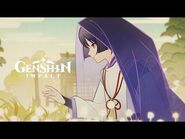
The Raiden Shogun uses the tall female model. She has pale skin, purple eyes with light blue pupils, and long, dark violet hair that becomes lighter at the ends, which glow when she uses her Elemental Skill or her Elemental Burst. She also has a beauty mark below her right eye.
During the Archon Quest Chapter II: Prologue - Autumn Winds, Scarlet Leaves, she is depicted as a tachi-wielding woman with long violet-colored hair that was worn down. She wore a kimono which is similar to the one she wears in the present day.
Quests and Events
Archon Quests
- Chapter II
- Chapter III
- Act III: Dreams, Emptiness, Deception
- The Gaze From a Certain God (cutscene)
- Act III: Dreams, Emptiness, Deception
Story Quests
Events
- Hues of the Violet Garden
- Akitsu Kimodameshi
- Part I: Test of Courage
- Duel! The Summoners' Summit!
- Round 3: Cards Out! Grievances Begone
- Iridescent Arataki Rockin' for Life Tour de Force of Awesomeness
- Enchanted Tales of the Mikawa Festival
- First Night: As Though Caught in a Dream
- Second Night: As Though Beholding Illusions
- Final Night: As Though Surrounded by Thunder
- After-Night: As Though Kissed by Dew
Story
History
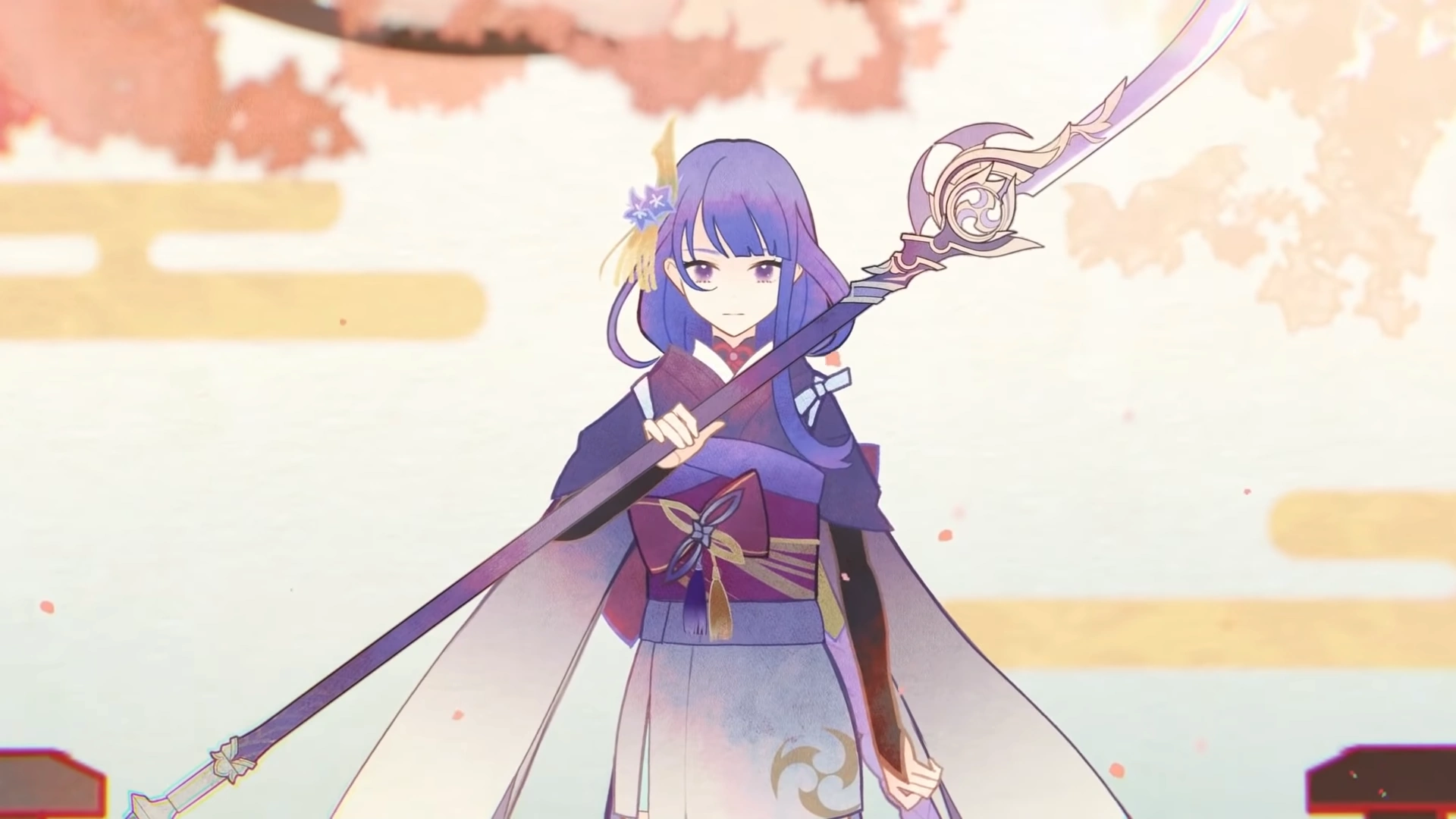

Ei as a kagemusha
Raiden Ei and Raiden Makoto were identical twin gods who lived during the start of the Archon War approximately 6,000 years ago.[17][Note 2] During the war, she conquered many youkai races; the youkai under her banner used their powers to help humans seek refuge in the mountains and also built Inazuma City, thus marking the beginning of Inazuma.[18][19] Around 2,000 years ago, Ei defeated all remaining gods in the archipelago, and together with Makoto, united the islands under the Inazuman Shogunate.[20][21]
While Ei was a far more formidable warrior than the peaceful Makoto, Ei believed Makoto to be a better ruler for humanity. According to Treasured Tales of the Chouken Shinkageuchi, Ei willingly sacrificed her body so that Makoto could ascend to Celestia instead of her and become one of The Seven; after becoming Electro Archon, Makoto recreated Ei's body and made Ei her kagemusha (Japanese: 影武者 "shadow warrior"), or body double.[22] As far as the world was aware, there were not two, but one. They complemented each other, and they ruled Inazuma jointly; therefore, there was no need for the public to know the truth. The Makoto's divine name "Baal" and the title of Raiden Shogun were understood to refer to both of them.[5]
All those who dwelled in the nation lived in peace as long as the Shogunate's borders were not threatened.[23] At some point after creating Watatsumi Island, the god Orobashi attacked Yashiori Island with his followers due to having been sentenced to death by Celestia for reading the book Before Sun and Moon, which recorded history that they wanted hidden, as well as paying for Enkanomiya's transgressions.[24] Ei rallied the Shogunate forces against the god and his followers. In the ensuing war, Sasayuri was killed and Ei killed Orobashi with the Musou no Hitotachi on the island with such force that it created the Musoujin Gorge. Neither Ei nor Makoto were aware of the true motive behind Orobashi's attack.[25]
After the last of The Seven ascended to their divine throne 2,000 years ago, and the Archon War came to an official end, Ei met Morax and Barbatos while accompanying Makoto to one of The Seven's occasional reunions in Liyue.[11][12]
At some point, Kapatcir begins to wreak havoc on Seirai Island. Being a threat to its inhabitants, Ei pursued and killed her.[26][27] As a result, the island was left in ruins, and the remnants of her power were suppressed by the protections of the Asase Shrine, where a coagulation of regret formed.[28][29]
During the cataclysm 500 years ago, the threat of the Abyss prompted Ei to take up arms once more alongside Makoto, Mikoshi Chiyo, and Kitsune Saiguu. When Ei learned that Makoto had gone to Khaenri'ah alone, she pursued her sister, tasking Saiguu with defending Inazuma.[30] By the time she had arrived, Makoto was already dying, much to Ei's horror, although the former archon was able to preserve some of her consciousness.[30] After returning from Khaenri'ah, Ei assumed her sister's position in both the Shogunate and as a member of The Seven.[30] Chiyo was swallowed by a "beast of sin";[31] while she broke out, she was corrupted by its taint and drew her sword against Ei.[32] In the ensuing fight, Ei sliced off Chiyo's horns and her sword-arm, but did not chase after the corrupted oni.[32] She used the powers of the Sacred Sakura to eliminate all of the monsters plaguing Inazuma, bringing peace back once more, though Saiguu had died in the process.[30] The incident left her deeply scarred from "erosion."
At some point after the cataclysm, through unknown means and with the help of Khaenri'ahn techniques, Ei created an experimental puppet as a proof of concept to see if she could "escape" erosion, who later called himself Kabukimono. She had wished to use him to store her Electro Gnosis, but the puppet shed tears upon creation, causing Ei to believe him to be too gentle for the task. Taking apparent pity on him, she decided to seal his powers and leave him in a slumber in the Narukami Shrine.[33]
About 400 years ago,[34] she created a puppet version of herself, making sure that it followed her ideals. Satisfied with her work, she gave her Gnosis to Miko before removing her consciousness from her body into the Musou Isshin.
This way, her people wouldn't be in danger of transgressing the Heavenly Principles and be punished for it, like Khaenri'ah did, and she herself would survive as their permanent god by preserving her consciousness free of erosion and keeping an indestructible artificial body, so that her people wouldn't suffer the loss she herself experienced when Makoto died.[35]
A year before the game's current events, the Shogun puppet was deceived by the Fatui and allowed the corrupt members of the Tri-Commission, headed by Kujou Takayuki, to enact both the Vision Hunt and Sakoku Decrees with Ei's tacit approval, shuttering her nation off from the rest of Teyvat. According to Zhongli, she had ordered the Inazuma Shogunate to collect all of the Visions in the country, where they were laid into the Statue of the Omnipresent God for reasons unknown. No one, including her people, has since been granted an Electro Vision.[8]
Present Day
During the Rite of Descension, Zhongli faked his death to see if Liyue could survive without him. He guessed that Ei would learn of his "death" and retirement, which would cause her to accelerate her plans.[8] Ei, for her part, believed that his story was not over yet.[11]
When the Traveler arrived on Inazuma to speak with Ei, they were instead roped by the resistance to help abolish the Vision Hunt Decree, first encountering her in the Plane of Euthymia when they attempted to intervene after the Shogun apprehended Thoma to take his Vision.[36] In this encounter, she defeated them, but the Traveler managed to escape thanks to Thoma's intervention.[36] While aiding the Watatsumi Army, they are rescued by Miko from Scaramouche,[37] who revealed that the Electro Archon is Ei, who they encountered in the plane; the one in the real world was actually her puppet.[38] She believed that Ei had taken an interest in them and assisted them in reaching her again for a rematch, believing that if they managed to defeat her, she would rescind the Vision Hunt Decree.[38] The Traveler met Ei again on the steps of Tenshukaku when the Shogun attempted to attack the Watatsumi Army, who had arrived to confront her. Drawing on the powers of the seized Visions with Miko's help, they were able to convince Ei to rescind the Vision Hunt Decree, returning all the seized Visions as long as their owners could be found.[35]
After learning of the full extent of the damage dealt to the nation, Ei immediately ordered the arrest of both the Kanjou and Tenryou Commissioners for their deception and started making changes to the Shogun's protocols to fit her new notions of Eternity.[15] However, she had made little progress in doing so as the Shogun was never intended to be changed and that it had begun to see her as an enemy of eternity following her change of mind[39] resulting in it rebelling against her to maintain the eternity she originally sought.
Ei managed to prove that her newfound resolve wasn't a product of erosion to the Shogun in a duel. As part of a new agreement, Ei would no longer rule the nation on the basis of fear of the Heavenly Principles, honoring past sacrifices instead of trying to prevent further loss by overprotecting Inazuma from the dangers of its progress.[40]
Though the Shogun becomes her kagemusha, Ei vows not to regard her as a mere tool of eternity, just like her sister did with herself, as she began to play a more active role in Inazuma's policies while the people of the nation began to know her as an individual instead of holding onto their unrealistic notion of a permanent and omnipresent god. The Sakoku Decree was also abolished, to the delight of many.[40]
Character Mentions
Character Stories
| Character | Stories |
|---|---|


Character Voice-Overs
| Character | Voice-Overs |
|---|---|
| |
| |
| |
| |
| |
| |
| |
| |
| |
| |
| |
| |
| |
| |
| |
| |
|


Mails
| Sender | Mails |
|---|---|
|
Trivia
- The pinnacle of Ei's swordsmanship is the Musou no Hitotachi (Japanese: 無想の一太刀 Musou no Hito-tachi, "One Slash of No Conception"), the symbol of ultimate power.[41] The sword skill is said to be only witnessed during "divine punishment."[41]
- The true identities of Ei, Makoto, and the puppet were hinted at before the release of the Raiden Shogun in Version 2.1:
- The Raiden Shogun's Character Teaser depicts a second individual bearing the likeness of Ei, who is later understood to be Makoto.
- Her Character Demo heavily emphasized the imagery of two Raiden Shoguns, which symbolizes Ei and the puppet sharing the same body.
- The English name for Vajrada Amethyst Gemstone hinted that the Raiden Shogun seen in Inazuma is a puppet. The real Ei is inside her weapon: At the time of the reveal, it was the only gemstone that did not derive its name from a Hindu god. Instead, its name comes from Vajra, the weapon wielded by Indra, the Hindu god of rain and thunder.
Aliases and Titles
- Ei is known by these aliases or titles:
- Beelzebul (divine name)[5][Note 1]
- Electro Archon[8]
- God of Eternity[8]
- Raiden Shogun[8]
- Shogun of Inazuma[8]
- Kagemusha (formerly)[22]
- Shadow Shogun (formerly)[22]
- Master of the Euthymic Plane[35]
- Great Gongen[42]
- Great and Excellent Ogosho, the Almighty Shogun[43]
- Her Excellency, the Almighty Narukami Ogosho, God of Thunder[44]
- Lord of Thunder[45]
- Omnipresent God[46]
- Ei is also known by these terms of address:
Etymology
- In Shinto mythology, Raiden (Japanese: 雷電 Raiden) is another name for Raijin, the kami, or god of lightning, thunder, and storms. Raiden also means "thunder and lightning" in both Japanese and Chinese.
- "Ei" (Japanese: 影) literally means "shadow". This is an allusion to her role as a body double for her sister Makoto, as "Makoto" (Japanese: 真) literally means "real" or "true".
- Ei is loosely based on Raiden Mei, a character from Houkai Gakuen 2 and Honkai Impact 3rd, other games created by miHoYo. Raiden Mei, Makoto, and Ei are strikingly similar to each other:
- Raiden Mei, Makoto, and Ei all have purple eyes and long purple hair.
- Raiden Mei, Makoto, and Ei all harness the power of lightning (Electro).
- Raiden Mei is the 3rd Herrscher (the Herrscher of Thunder), while Baal is the third among the Seven Archons to appear.
- Honkai Impact 3rd also has an official manga titled "Escape from Nagazora." It has a chapter called "The Wrath of Baal," which showcases Mei's first appearance as the Herrscher of Thunder.
- Raiden Mei, Makoto, and Ei are all voiced by the same voice actress in Japanese, Miyuki Sawashiro (沢城 みゆき) and the same voice actress in Chinese, Juhuahua (菊花花).
- Both characters have fought an elite member of a powerful organization. Said members are also associated with Lepidoptera (butterflies/moths). The Raiden Shogun fought Signora, whose surname (Lohefalter) means "blazing butterfly," while Raiden Mei fought a simulation of Aponia. Aponia is also a genus of moths from the family Crambidae.
- Beelzebub (also spelled Beelzebul) was the name of a Philistine deity and is known in Demonology as one of the Seven Princes of Hell. Many Christian theological sources recognize the name Beelzebub as another name for Satan.
- The source for the name Beelzebub comes from the Book of Kings in the Hebrew Bible, written as בַּעַל זְבוּב Baʿal Zəvûv. As such, Ba'al was a title and honorific meaning "owner" or "lord" in antiquity.
- So far, Beelzebul is the only Archon name that does not appear in the Ars Goetia.
- Beelzebul as a shogun is most likely inspired by Tokugawa Ieyasu (1543–1616), the founder and first shogun of the Tokugawa Shogunate (1603–1868).
- The Japanese name of her constellation is 天下人座 Tenkabito-za, "Seat of the Person under the Heaven". 天下人 Tenkabito means a person who virtually holds the reins of the nation and usually refers to three powerful warlords: Oda Nobunaga, Toyotomi Hideyoshi, and Tokugawa Ieyasu, of which the last is the only 天下人 tenkabito who became a shogun.
- Although the official decree of Sakoku was issued under the reign of his grandson, there were several precursors of the Sakoku decree during Ieyasu's reign.
- Like Ei, Ieyasu was skilled in swordsmanship. He is said to have mastered the Ichi no Tachi (Japanese: 一之太刀 Slash of One) in his later years, the ultimate sword art of the Kashima Shintou school that only a chosen few were allowed to learn,[50] which may have inspired the "Hitotachi" (Japanese: 一太刀 One Slash) part of the Musou no Hitotachi (see later part for "Musou").
- Ieyasu also patronized two swordsmen and their schools: Yagyuu Munenori of the Yagyuu-Shinkage school and Ono Tadaaki of the Ittou school. The former school may have inspired the swordsman Iwakura Michihiro in the game (see the article for details). The latter school is known for the semi-legendary sword art Musouken (Japanese: 夢想剣 Sword of the Dream), which may have inspired the name of Musou Shinsetsu (Japanese: 夢想真説 True Teachings of the Dream), the Elemental Burst of the playable Raiden Shougun (but not "Musou" in the Musou no Hitotachi during the story and in past legends, which has a different kanji).
- There is a conspiracy theory that Ieyasu had a kagemusha (body double) and the kagemusha took the place of real Ieyasu at some point in the history.[51] It is not taken a serious consideration by historians but is a popular theme in Japanese historical fictions. This theory may have inspired the in-game lore that Ei was originally a kagemusha of Makoto.
- Ei as the God of Eternity is likely inspired by the shogun Tokugawa Ieyasu's faith in Pure Land Buddhism.
- Her title "Plane of Euthymia" is called "Pure Land of One Mind" (Japanese: 一心浄土 Isshin Joudo) in the East Asian versions, which refers to the realm of perfect purity and quietude in one's mind, namely a Buddhist version of idealism that all beings arise from mind and thus buddhas and their meditation realms (Pure Land) also reside in one's own mind.[52] Historically, Ieyasu was an avid follower and patron of the Pure Land School (Japanese: 浄土宗 Joudo-shuu), and he adopted the school's slogan "Abhor the Impure Land, Aspire to the Pure Land" (Japanese: 厭離穢土 欣求浄土 Enri-Edo Gongu-Joudo) as his banner sign.[53]
- Unlike other schools of Buddhism (which are generally anti-dogmatic and embrace impermanence), Pure Land Buddhism emphasizes a strong faith in Amida (Japanese: 阿弥陀), the Buddha of Infinity. The name Amida comes from the Chinese name Ēmítuó (Chinese: 阿弥陀), which in turn is the combination of two Sanskrit names: Amitābha (Sanskrit: अमिताभ) meaning "Infinite Light" and Amitāyus (Sanskrit: अमितायुस्) meaning "Infinite Longevity." Both properties of Amida match Ei's orientation to eternity (especially eternal longevity).
- After the cataclysm, Ei claimed her body was the most eminent in the world and promised never-changing eternity to her people. Similarly, Ieyasu was posthumously deified as a dai-gongen, or a great manifestation of a buddha as a Shinto god, because he claimed he wanted to be a guardian of the nation even after his mortal life ended.[54] In addition, Ieyasu's slogan "Abhor the Impure Land, Aspire to the Pure Land" is alleged to represent his determination to end the cataclysm of the Sengoku period (Warring States period) and build a pure land in this world by bringing peace.[53]
- The Statue of the Thousand-Armed, Hundred-Eyed God is most likely a reference to Senju-Kan'non (Japanese: 千手観音 "Thousand-Armed Avalokiteśvara"), a manifestation of the bodhisattva Kan'non (Japanese: 観音; Sanskrit: अवलोकितेश्वर Avalokiteśvara), one of the two main assistants of Amida.
- In her realm, Ei meditates in the sitting position of hanka fumisage (Japanese: 半跏踏下 "half-lotus pendant"), a variant of the half-lotus position (but not necessarily a foot has to be placed on a thigh). In Buddhist art in Japan, this position is commonly used to depict the bodhisattva Miroku (Japanese: 弥勒; Sanskrit: मैत्रेय Maitreya), an object of worship in Pure Land Buddhism that predates worship for Amida. Miroku is said to confine himself in his realm of Pure Land for meditation to achieve enlightenment and bring salvation to all sentient beings. Until the expected achievement of his enlightenment, he is believed to send his avatars to help this world on behalf of him. Beelzebul's self-confinement in her realm of Euthymia ("Pure Land" in the East Asian versions) and her use of a puppet for the mundane world may be inspired by this belief.
- Ei's ultimate sword skill Musou no Hitotachi is most likely a reference to the Munen-Musou no Uchi (Japanese: 無念無想の打 "Strike of No Design, No Conception"), created by the swordsman Miyamoto Musashi, who is often called a "sword saint."
- Musou is short for Munen-Musou (Japanese: 無念無想 "No Design, No Conception"). According to Victor Harris, a former Keeper of Japanese Antiquities at the British Museum in London, munen-musou in Japanese swordsmanship means "the ability to act calmly and naturally even in the face of danger. It is the highest accord with existence when a man's word and his actions are spontaneously the same."[55]
- According to Musashi's The Book of Five Rings (translated by Victor Harris), "In this method, when the enemy attacks and you decide to attack, hit with your body, and hit with your spirit, and hit from the Void with your hands, accelerating strongly. This is the "No Design, No Conception" cut. This is the most important method of hitting. It is often used. You must train hard to understand it."[55]
- Ei's (alleged) past fondness for Shiba dogs is most likely a reference to Tokugawa Tsunayoshi, the fifth shogun of the Edo Bakufu (Tokugawa Shogunate). He was nicknamed as the Dog Shogun (Japanese: 犬公方 Inu-Kubou) because of his eagerness to enact animal protection laws.
Gallery





Genius Invokation TCG


Notes
- ↑ 1.0 1.1 The concept of a divine name is established in the original Chinese text of Archon Quest Wishes in Chapter II: Act III - Omnipresence Over Mortals. The relevant line reads: 不论是「巴尔」这个魔神名讳,还是雷电将军这个称谓,其实一直都可以看做是同时指代她们两人的,直到… "In fact, the name "Baal" and the title of Raiden Shogun was understood to refer to both of them, right up until—," lit. "Whether it's the sacred god name Baal or the title of Raiden Shogun, both names were simultaneously used to refer to [both of] them, until..." However, as the concept was not carried over into the English localization, this page will use the localization for "神名" as provided in the description for Mavuika's Elemental Skill The Named Moment: "Divine Name".
- ↑ Aberaku is stated in World Quest Counterfeit Classics in Series A Long Day in the Mountains: Chapter 1 - Paradise to have been alive during the era of the unified civilization and was later imprisoned by the first Sunchild, Rikoru. Seven Sunchildren existed in total, all of whom died as children, which places the maximum possible length of their total regime at around a century before it was overthrown by Orobashi, who had fled from Ei during the Archon War. This places the start of Ei's participation in the Archon War at most around a century or two after the conclusion of the war of funerary flame 6,000 years ago.
Other Languages
Raiden Ei
| Language | Official Name |
|---|---|
| English | Raiden Ei |
| Chinese (Simplified) | 雷电影 Léidiàn Yǐng |
| Chinese (Traditional) | 雷電影 Léidiàn Yǐng |
| Japanese | 雷電影 Raiden Ei |
| Korean | 라이덴 에이(影) Raiden Ei |
| Spanish | Raiden Ei |
| French | Raiden Ei |
| Russian | Райдэн Эи Rayden Ei |
| Thai | Raiden Ei |
| Vietnamese | Raiden Ei |
| German | Raiden Ei |
| Indonesian | Raiden Ei |
| Portuguese | Raiden Ei |
| Turkish | Raiden Ei |
| Italian | Raiden Ei |
Beelzebul
| Language | Official Name |
|---|---|
| English | Beelzebul |
| Chinese (Simplified) | 巴尔泽布 Bā'ěrzébù |
| Chinese (Traditional) | 巴爾澤布 Bā'ěrzébù |
| Japanese | バアルゼブル Baaruzeburu |
| Korean | 바알세불 Baalsebul |
| Spanish | Beelzebul |
| French | Belzébuth |
| Russian | Вельзевул Vel'zevul |
| Thai | Beelzebul |
| Vietnamese | Beelzebul |
| German | Beelzebul |
| Indonesian | Beelzebul |
| Portuguese | Beelzebul |
| Turkish | Beelzebul |
| Italian | Beelzebul |
Change History
References
- ↑ Twitter: EN VA Announcement
- ↑ HoYoverse Chinese News: 2.0版本PV:「不动鸣神,泡影断灭」
- ↑ Twitter: JP VA Announcement
- ↑ Twitter: KR VA Announcement
- ↑ 5.0 5.1 5.2 5.3 5.4 5.5 Archon Quest, Chapter II, Act III - Omnipresence Over Mortals, Part 9: Wishes
- ↑ Raiden Shogun's Character Story: Character Story 2
- ↑ Raiden Shogun's Character Story: Character Story 1
- ↑ 8.0 8.1 8.2 8.3 8.4 8.5 8.6 Archon Quest, Chapter I, Act III - A New Star Approaches, Part 6: The Fond Farewell
- ↑ Neuvillette's Voice-Over: About the Electro Archon
- ↑ Raiden Shogun's Character Story: Gnosis
- ↑ 11.0 11.1 11.2 Raiden Shogun's Voice-Over: Morax
- ↑ 12.0 12.1 Raiden Shogun's Voice-Over: Venti
- ↑ Raiden Shogun's Character Story: Character Story 2
- ↑ Story Quest, Raiden Shogun, Imperatrix Umbrosa Chapter: Act II - Transient Dreams, Part 2: Farewell to the Past
Ei: Though she is a puppet, the Shogun has her own consciousness, too. When necessary, she appears here to confront me. - ↑ 15.0 15.1 15.2 Story Quest, Raiden Shogun, Imperatrix Umbrosa Chapter: Act I - Reflections of Mortality, Part 1: The Lonesome Euthymia
- ↑ Story Quest, Raiden Shogun, Imperatrix Umbrosa Chapter: Act I - Reflections of Mortality, Part 3: The Fabric of Constancy
- ↑ Weapon: Oathsworn Eye
- ↑ Yae Miko's Character Story: Character Story 4
- ↑ Raiden Shogun's Character Story: Character Details
- ↑ Book: A Preliminary Study of Sangonomiya Folk Belief
- ↑ Book: The Life of Mouun the Shrine Maiden
- ↑ 22.0 22.1 22.2 Book: Treasured Tales of the Chouken Shinkageuchi, Vol. 1
- ↑ Book: Sangonomiya Chronicles
- ↑ World Quest, From Dusk to Dawn in Byakuyakoku: The Subterranean Trials of Drake and Serpent
- ↑ Book: Sangonomiya Chronicles
- ↑ Artifact Set: Thundering Fury
- ↑ YouTube: Story Teaser: Promise of a People's Dream
- ↑ World Quest, Through the Mists: The Sun-Wheel and Mt. Kanna
- ↑ World Quest Act: Seirai Stormchasers
- ↑ 30.0 30.1 30.2 30.3 Story Quest, Raiden Shogun, Imperatrix Umbrosa Chapter: Act II - Transient Dreams, Part 1: Cleansing Light
- ↑ Artifact, Emblem of Severed Fate: Magnificent Tsuba
- ↑ 32.0 32.1 Weapon Ascension Material: Mask of the Kijin
- ↑ Artifact Set: Husk of Opulent Dreams
- ↑ Archon Quest, Interlude Chapter, Act III - Inversion of Genesis, Part 1: The Night-Bird Falls at the Curtain's Call
- ↑ 35.0 35.1 35.2 Cite error: Invalid
<ref>tag; no text was provided for refs namedThe Omnipresent God - ↑ 36.0 36.1 Archon Quest, Chapter II, Act II - Stillness, the Sublimation of Shadow, Part 1: Amidst Stormy Judgment
- ↑ Archon Quest, Chapter II, Act III - Omnipresence Over Mortals, Part 3: Delusion
- ↑ 38.0 38.1 Archon Quest, Chapter II, Act III - Omnipresence Over Mortals, Part 4: The Servant's Path
- ↑ Raiden Shogun's Character Story: Character Story 5
- ↑ 40.0 40.1 Story Quest, Raiden Shogun, Imperatrix Umbrosa Chapter: Act II - Transient Dreams, Part 3: Radiant Sakura
- ↑ 41.0 41.1 Archon Quest, Chapter II, Prologue - Autumn Winds, Scarlet Leaves, Part 3: Follow the Wind (Cutscene)
- ↑ Book: Toki Alley Tales, Vol. 2
- ↑ Quest Item: Official Tenryou Commission Document
- ↑ Event Duel! The Summoners' Summit! Quest: Round 3, Part 1: Cards Out! Grievances Begone
- ↑ Weapon Lore: Akuoumaru
- ↑ Story Quest Act, Raiden Shogun, Imperatrix Umbrosa Chapter: Act I: Reflections of Mortality
- ↑ 47.0 47.1 NPC Dialogue: Inagi Hotomi
- ↑ Inazuma, Narukami Island, Viewpoint: Tenryou, Inazuma City
- ↑ World Quest: Sakura Arborism
- ↑ Kotobank: 塚原卜伝
- ↑ Japanese Wikipedia: 徳川家康の影武者説 "Kagemusha Theory of Tokugawa Ieyasu"
- ↑ Grand Dictionary of Joudo-Shuu: 己心の弥陀・唯心の浄土
- ↑ 53.0 53.1 Grand Dictionary of Joudo-Shuu: 新纂浄土宗大辞典:厭離穢土欣求浄土
- ↑ Tokyo Museum Collection: Portrait of Tokugawa Ieyasu
- ↑ 55.0 55.1 Miyamoto Musashi: Book of Five Rings - The Water Book
| ||||||||||||||||||||||||||||||


