Seven Pillars
Last updated 2026-08-22

The Seven Pillars, also called the Seven Sages or the seven monk-kings,[1] were the retainers of King Deshret.[2][3]
Overview
The Seven Pillars were given power by King Deshret to act as his "pyramid of authority."[4] Heryshaf was the deputy-king of the King Deshret's civilization, and the chief of the Seven Pillars. Sobek is said to have had dominion over all weapons of war and Thoth is credited with inventing the desert script and its arcane arts.[5] Heryshaf, Sobek, and Thoth were considered the highest ranking members, collectively referred to as the "Three Retainers" (Chinese: 三佞臣 Sān Nìngchén, lit. "Three Sycophantic Ministers"),[6] but also as the most treacherous advisors to King Deshret.[7][8] Little was known historically about who Bennu and Shesepankh were and what positions they held, but they have been referred to as embodying King Deshret's "soul" and "will" respectively.[1] It is later revealed that the two were constructs of artificial intelligences, programmed by Deshret with autonomous will, and that Bennu was entrusted with the duty of guarding the gates of Aaru, while Shesepankh had the duty of overseeing all the Jinn of the world.[9][10] The shield of Aaru Village's Guardian is said to bear the blessing of Bennu.[11]
Most of the Pillars have a specific animal association and color-scheme. Heryshaf is depicted wearing a blue-violet garment; Thoth is typically depicted wearing red garments; Sobek typically wears blue garments. Hermanubis is usually shown in purple garments and with a jackal head. Bennu is said to resemble a "great bird winging skyward towards the sun," and Shesepankh is said to resemble "a lioness with a human head."[1]
Members
Only information from Guiding Notes is listed here. For more information, see Trivia.
| Icon | Name | Title | Epithet | Status |
|---|---|---|---|---|
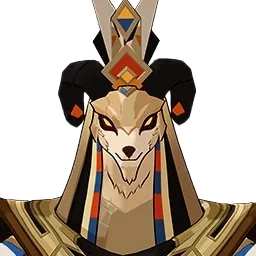
|
Heryshaf | Goat King | Minister of Ministers | Alive |
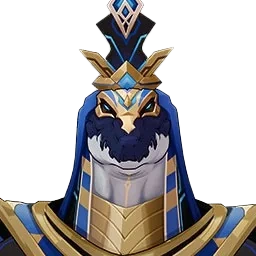
|
Sobek | Crocodile King | Captain of Captains | |
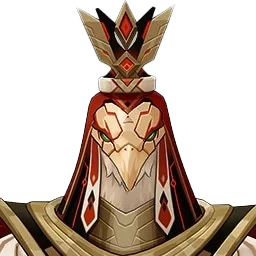
|
Thoth | Ibis King | Scribe of Scribes | |
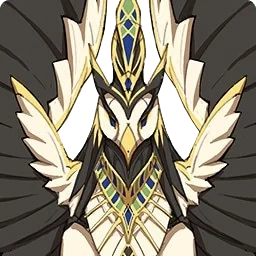
|
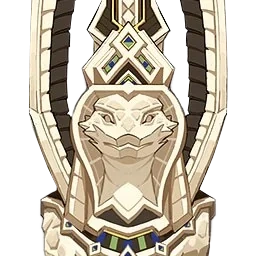
Bennu | Most-Radiant | Saint | |
|
Shesepankh | Most-Holy | Saint | |
|
Apep | Dragon King | Supreme Spirit | Alive (refuses to acknowledge membership) |
|
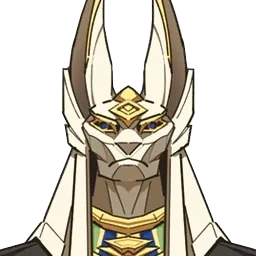
Hermanubis | Greatest of Sages | Saint | Deceased |
History
Several thousand years ago, King Deshret divided up his power amongst several sages across the desert.[12] According to the lore of the Temple of Silence, the sage Hermanubis was chosen from amongst the Tighnarians to be Deshret's familiar and one of his ministers.[13] King Deshret considered the Dendro Dragon Sovereign, Apep, to be one of the Seven Pillars, but she did not see herself as one of them and never met with the other Pillars.[5][2] According to ancient texts, Bennu and Shesepankh refer more to "human souls" and "Jinni." They have also been described as Deshret's "soul" and "will," respectively. Heryshaf, Sobek and Thoth, as well as Hermanubis, are considered the most important members, with Heryshaf being the "right hand" of King Deshret and the head of the Seven Sages.[1][2]
It is said the former trio, seeing how Deshret mourned his losses, pushed Deshret to rebel against the Heavenly Principles and make use of forbidden knowledge. Twice they were rebuked, Deshret shutting down first Heryshaf then Thoth, but Sobek eventually convinced Deshret to give in and seek immortality.[6]
For committing unknown sins,[14] King Deshret later banished the three to Aaru, where they remain imprisoned for hundreds, if not thousands of years.[15] After Deshret's own death, Apep acted on their prior agreement and consumed his physical body, but became contaminated by Forbidden Knowledge. Hermanubis took his followers to Tulaytullah and established the Temple of Silence; eventually they were attacked by the king of Gurabad, leading Hermanubis to shatter himself into Ba fragments so his followers could use his power to defend themselves. Two Ba fragments survive to the present day, currently fused within Cyno.
Despite his imprisonment in Aaru, Thoth is able to temporarily possess the cats in his temple to converse with humans alongside that of Sobek and Heryshaf. Before entering Aaru, Deshret told Thoth that if he found humans to provide the correct answers to three questions posed by Nabu Malikata, he could be released from his seal. Goudarz and Makhaira each answered the first and second question, respectively. Thoth found their answers intriguing and satisfying, and so they were rewarded with some of his power in exchange. Around 500 years ago, the researcher Zandik also came in contact with him, but he refused Thoth's gift. The third answer was then posed to Nefer some time before the events of the game, but Nefer gave her own answer, not trusting Thoth at the time. Thoth was disappointed to learn that Nefer's answer was not correct, but bided his time.[5]
Nefer later visited Sumeru to help her former nation after learning of the situation there from the angel Nicole. Since the Seven Pillars were necessary to unlock Aaru's Shut, the group initially lamented the fact that they could not free Thoth, Sobek and Heryshaf, given that they were still imprisoned by Deshret. Fortunately, Nefer arrived and after giving the true answer to the third question - which she suspected was also the true answer to the two previous questions -, Thoth, Sobek and Heryshaf were released from their imprisonment and regained their physical forms. They also activated Bennu and Shesepankh, and all Seven Pillars (barring Apep) agreed to unseal Aaru's Shut and allowed the people of Sumeru to modify it. In the aftermath of Irminsul's destruction, Thoth and Heryshaf decided to ask Sethos if they could stay in the Temple of Silence, and presumably Sobek would follow suit.[16]
Gallery

Statues


Murals and Slabs

An Introduction to Indoor Archaeology


Headlong Into the Sands


Quest Stills


Trivia
- Each of the Seven Pillars have individual styles of office. The following is a combination of instances for the full forms of address, showing translation liberty in the English localization:[Note 1]
- 羊之王·众相之相赫里沙夫 "Goat King Heryshaf, Minister of Ministers," lit. "Goat King, Minister of Ministers Heryshaf"[2]
赤王七柱之一,众相之相·羊之王 "One of King Deshret's Seven Pillars, the Minister of Ministers, the Goat King"[10] - 鳄之王·众统帅之统帅索贝克 "Crocodile King Sobek, Captain of Captains," lit. "Crocodile King, Captain of Captains Sobek"[2]
赤王七柱之一,众统帅之统帅·鳄之王索贝克 "One of King Deshret's Seven Pillars, the Captain of Captains, Sobek the Crocodile King," lit. "One of King Deshret's Seven Pillars, the Captain of Captains, the Crocodile King Sobek"[10] - 鹮之王·众书记之书记图特 "Ibis King Thoth, Scribe of Scribes," lit. "Ibis King, Scribe of Scribes Thoth"[2]
赤王七柱之一,众书记之书记·鹮之王 "One of King Deshret's Seven Pillars, the Scribe of Scribes, the Ibis King"[10] - 至贤·赫曼努比斯 "Hermanubis, greatest of sages," lit. "Most Wise, Hermanubis"[2]
众贤之至贤赫曼努比斯 "Hermanubis, the greatest of all sages," lit. "Most Wise of all Sages Hermanubis"[17]
众祭司之祭司,赫曼努比斯大人 "The great Hermanubis, priest over all other priests," lit. "Priest of Priests, Great Hermanubis"[18]
赤王七柱之一,至贤·圣者赫曼努比斯 "One of King Deshret's Seven Pillars, Saint Hermanubis, the Greatest of Sages," lit. "One of King Deshret's Seven Pillars, the Greatest Sage of all Sages, Saint Hermanubis"[10] - 至明·贝努 "Bennu Most-Radiant," lit. "Most Radiant, Bennu"[2]
赤王七柱之一,至明·圣者贝努 "One of King Deshret's Seven Pillars, Saint Bennu, the Most-Radiant," lit. "One of King Deshret's Seven Pillars, the Most-Radiant, Saint Bennu"[10]
那飞向太阳的鸟、王之心魂——圣者贝努 "The great bird winging skyward towards the sun, the King's soul — The saint Bennu," lit. "That sunward-flying bird, the king's spirit — the Holy Bennu"[1] - 至圣·谢斯芬赫 "Shesepankh Most-Holy," lit. "Most Holy, Shesepankh"[2]
赤王七柱之一,至圣·圣者谢斯芬赫 "One of King Deshret's Seven Pillars, Saint Shesepankh, the Most-Holy," lit. "One of King Deshret's Seven Pillars, the Most-Holy, Saint Shesepankh"[10]
那狮身人面者、王之意志——圣者谢斯芬赫 "The lioness with a human head, the King's will — The saint Shesepankh," lit. "That sphinx, the king's will — the Holy Shesepankh"[1] - 龙之王·至灵阿佩普 "Dragon King, the supreme spirit Apep," lit. "Dragon King, Supreme Spirit, Apep"[2]
赤王七柱之一,龙之王·至灵 "One of King Deshret's Seven Pillars, the Dragon King, the supreme spirit"[10]
- 羊之王·众相之相赫里沙夫 "Goat King Heryshaf, Minister of Ministers," lit. "Goat King, Minister of Ministers Heryshaf"[2]
- The introductory cards for the Great Red Sand-associated characters (Candace, Dehya, and Sethos) depict four animals. Clockwise from left to right, they represent: the Goat King, the Ibis King, the Dragon King, and the Crocodile King.
- In Archon Quest Song of the Welkin Moon: Act IX - As All Falls to Emptiness, Heryshaf refers to Cyno as "Hermanubis's representative".[14]
In Archon Quest Song of the Welkin Moon: Act X - Truth Amongst the Pages of Purana, Bennu states that the image on Candace's shield is one of him, which is why he can appear there. Likewise, Shesepankh remarks that his image is carved upon Dehya's gauntlet.[19]
Etymology
- The Seven Pillars derives their names from several deities of Egyptian mythology:
- Heryshaf (Egyptian: ḥrj šf lit. "He who is on His Lake") is a god associated with rams and is depicted as ram-headed. The in-game Heryshaf however, who is titled the "Goat King," seems to instead be associated with goats.
- Apep (Egyptian: ꜥꜣpp), perhaps better known as Apophis (Ancient Greek: Ἄποφις Ápophis), is the serpentine god of chaos and Ra's main adversary.
- Thoth (Egyptian: ḏḥwtj lit. "[he] is like the ibis") is a ibis-headed lunar deity and the scribe of the gods.
- Hermanubis (Ancient Greek: Ἑρμάνουβις Hermánoubis; Coptic: ϩⲉⲣⲙⲁⲛⲟⲩⲡ) is a hybrid Greco-Egyptian god. He combines the Greek god Hermes and the Egyptian god Anubis. Both were conductors of souls in their respective myths which would eventually become the basis for Hermanubis' role in his own mythology.
- Sobek (Egyptian: sbk) is a primeval crocodile-headed god. This depiction comes from his association with the Nile crocodile, whom the Egyptians believed to be a physical manifestation of Sobek.
- Shesepankh (Egyptian: šzp-ꜥnḫ lit. "living image"), more famously known through its Greek form the Sphinx (Ancient Greek: Σφῐ́γξ Sphĭ́nx), is a mythical creature depicted with the body of a lion and the head of a human. Genshin impact's Shesepankh, in the Dialogues of the Desert Sages, is described as a lioness with a human head.
- Bennu (Egyptian: bnw) is a bird-like deity who represents creation, rebirth and immortality. Due to the many resemblances with the Phoenix from Greek mythology, it is widely believed that the myth of the Phoenix could have been rooted in the one of Bennu.
- Among the names of the Seven Pillars, Hermanubis's stands out as the only one to be based a Greek hybrid name over an Ancient Egyptian name alone.
Notes
- ↑ In Event Ruins Exploration: Fieldwise Center Quest, Ruins Exploration: Act II, Part 1: Headlong Into the Sands, according to Thoth's telling, Mehrak's official name uses the old tongue and needs to be translated into modern language, but it's not important nowadays. From that, we have a chance to guess what their own attitude was toward the name.
Other Languages
| Language | Official Name | Literal Meaning |
|---|---|---|
| English | Seven Pillars | — |
| Chinese (Simplified) | 七柱 Qī Zhù | Seven Pillars |
| Chinese (Traditional) | 七柱 Qī Zhù | |
| Japanese | 七柱 Nanahashira | Seven Pillars |
| Korean | 일곱 기둥 Ilgop Gidung | Seven Pillars |
| Spanish | Siete pilares | |
| French | Sept piliers | Seven Pillars |
| Russian | Семь столпов Sem' stolpov | |
| Thai | เจ็ดเสาหลัก | |
| Vietnamese | Bảy Trụ Cột | |
| German | Sieben Säulen | Seven Pillars |
| Indonesian | Tujuh Pilar | |
| Portuguese | Sete Pilares | |
| Turkish | Yedi Sütununun | |
| Italian | Sette Colonne |
Change History
References
- ↑ 1.0 1.1 1.2 1.3 1.4 1.5 1.6 Weapon: Dialogues of the Desert Sages
- ↑ 2.00 2.01 2.02 2.03 2.04 2.05 2.06 2.07 2.08 2.09 NPC Dialogue: Asenath
- ↑ Story Quest, Cyno, Lupus Aureus Chapter: Act II - Oathkeeper, Part 2: After Repose
- ↑ Story Quest, Cyno, Lupus Aureus Chapter: Act II - Oathkeeper, Part 3: Footprints Sunken Beneath the Sands
- ↑ 5.0 5.1 5.2 Event Ruins Exploration: Fieldwise Center Quest, Ruins Exploration: Act II, Part 1: Headlong Into the Sands
- ↑ 6.0 6.1 Book: The Lay of Al-Ahmar
- ↑ Nefer's Character Story: Moon Wheel
- ↑ NPC Dialogue: Charmian
- ↑ Archon Quest, Song of the Welkin Moon, Act IX - As All Falls to Emptiness, Part 3: Ancient Shadows Re-Emerge
- ↑ 10.0 10.1 10.2 10.3 10.4 10.5 10.6 10.7 Game System: Guiding Notes
- ↑ Candace's Voice-Over: More About Candace: IV
- ↑ Weapon Ascension Material: Olden Days of Scorching Might
- ↑ Story Quest, Cyno, Lupus Aureus Chapter: Act II - Oathkeeper, Part 5: The Dead Past is the Living Present
- ↑ 14.0 14.1 Archon Quest, Song of the Welkin Moon, Act IX - As All Falls to Emptiness, Part 3: Ancient Shadows Re-Emerge
- ↑ Archon Quest, Song of the Welkin Moon, Act IV - An Elegy for Faded Moonlight, Part 3: Echoes of Fate
- ↑ Archon Quest, Song of the Welkin Moon, Act X - Truth Amongst the Pages of Purana, Part 4: Your Past Is Like a Garden
- ↑ Sethos's Character Story: Character Story 3
- ↑ Story Quest, Cyno, Lupus Aureus Chapter: Act II - Oathkeeper, Part 4: Sage of Sages
- ↑ Archon Quest, Song of the Welkin Moon, Act X - Truth Amongst the Pages of Purana, Part 3: Truth Amongst the Pages of Purana
| |||||||||||||||||||||||||||||||